Tuesday, 1 February 2011

Trip to ZhuHai, China

BBBBBBBBBBBBBBBBBBBBBBBBBBBBB!      Last week the trip to China was nice, I went on the boat survey for three days. The survey vessel we are using is a shrimp trawler, a fishing boat with outriggers with a forward deckhouse. During fishing operation, the outriggers extend out over the sides of the vessel to for fishing nets dragging. We started catching fish after work and preparing for the seafood feast! We had lots of little crabs, shrimps and fish, they were super fresh and yummmmm♥ Vincent told me they got a huge cod the evening after I left, so jealous>.<

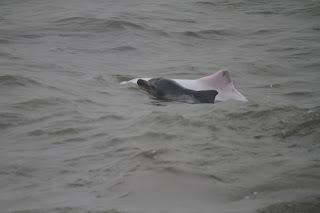
      We had a few sightings each day in Lingding Bay, including unspotted calve sighting. The little baby dolphin was so cuteee, always surfacing with her mother. She seems like she’s struggling with the wavy sea surface, swimming up awkwardly. She’s accompanied by several adults and an unspotted juvenile, looks like they are having a nice family time. Looking at this peaceful scene, I could truly understand the value marine mammals living freely in the wild without any constraints.


robin

Tuesday, 25 January 2011

Movie: "The Cove"

        'The Cove’ was one of the most influential, and perhaps heartbreaking documentary movie I have ever seen. It is about issues of dolphin slaughter that takes place regularly in a quiet cove in Taiji, Japan. Thousands of dolphins are trapped, some are captured and sold to dolphin aquariums, but most to be brutally killed for food. The team of activist, filmmakers and free divers are on a mission to record footages of the slaughter to expose it to the world. They go in at night with night vision and set up camera disguised as ordinary rocks. Since the local people will do anything to protect their secret slaughter, it’s an act of incredible risk to infiltrate the cove. According to the film, most of the people in Japan have no idea about the dolphin harvest in Taiji and they don’t eat dolphin. They have a right to know that the government is letting the sale of mislabeled meat and is toxic (high level of mercury concentration). So why does these horrifying acts still happening and will the people in Taiji survive without doing this? To me this is an interesting aspect of the film. This documentary film isn’t trying to give the audiences an opinion, it is only filmed to give you a view of a situation. I think it is not propaganda, meaning the audiences are able to understand if the point of view is a truthful illustration of the topic because it isn’t just a single side of the controversy.

        For me the footages of dolphin slaughtering certainly deliver the unethical process. This is like seeing a baby seal beat to death, except we might think baby seals are adorable. The Cove also emphasizes dolphins are smart animals that they are self-conscious. A few scenes in the movie are showing bleeding dolphins struggle for their last breath, to actually see their suffering, is devastating. The Cove is hard to watch sometimes, and the slaughter scenes are certainly not for the heartache but it is something that needed to be exposed. I hope the movie will bring a slight change in whaling policy, it’d be more helpful for the audiences willing to do more than just hand clapping.

robinnnnn

helloooooo

        It’s been a delightful experience going out for boat survey, enjoying the moments with these beautiful and energetic creatures in the wild^^ Before entering HKDCS I didn’t have much knowledge about dolphins and the problems they are facing in the world, I was getting the wrong messages from sea aquariums about marine mammals captivity and welfare. I have misunderstood the information that whales and dolphins performing in aquariums are living in standard, don’t need to worry about food and having a good time with ‘smile’ on their faces. When I actually go on the boat survey to watch wild dolphins swimming freely, chasing fish occasionally and relaxing in the afternoon, I realized that captivity for them is unethical and causes several physical, mental health problems leading to high mortality rate. Two weeks after my internship has started, I slowly built up my knowledge about the ecology and ranging patterns of cetaceans, humpback dolphin and finless porpoise in particular. Every effort made in the field and slight changes of the environmental variables recorded on datasheet can have significant alternation on the results, therefore it’s crucial to keep the errors in minimum. Consistency is another essential part of doing line transect surveys, it allows a comparison of results over different temporal scales, and to detect changes from both population and individual levels.

robin

Friday, 9 July 2010

My intership is coming to an end

I am finishing my internship with a session of land-based observation in Tai O tomorrow. It has been a great pleasure working with everyone at HKDCS/HKCRP and I thank them for their support in the past two months. I am also grateful for their friendship, without which it would not have been possible for them to tolerate my millions of questions (sorry can't help it - I love questions!). I would like to give a special shout-out to Samuel, who has been so supportive of my work in the internship programme as well as my dissertation work. Thank you very much!

In this internship, I have learnt a lot about cetaceans and local conservation work on them. I am glad to have been introduced to the wild dolphins and porpoises in a scientific way, and it definitely helped me better understand how these animals can be studied in the field. I hope everyone will do their part, however seemingly insignificant, to protect these magnificant creatures and the environment which we all live in.

Thursday, 1 July 2010

Dolphins said goodbye...

It was Theresa's last day at work yesterday. We surveyed North-West and West Lantau and had 17 sightings in total. We said that the dolphins came to say goodbye to Theresa :-) It's been a great pleasure working with her and she's taught me so much in the past two months. I wish her success in the future.

We met a group of playful juveniles in the afternoon and recorded their sounds while they socialised. Sometimes they were so loud that we heard them even without putting the headphones on! Theresa had to help Vincent make the recordings, so I was put in charge of photographing dolphins for the first time. They surfaced together for most of the time so it wasn't too difficult to spot them and photograph their dorsal fins.

On another occasion, I spotted a dolphin which the two observers on shift had missed. Vincent (not on shift at the time) confirmed it as an off-effort sighting. I think I've definitely become very sensitive to the presence of dolphins now!

Monday, 21 June 2010

Land-based observations last week and Po Toi today

We spent most of last week in the office, except on Thursday and Saturday when Higher and I observed dolphins in Tai O. There were lots of vessels on the sea on both days (12 vessels at one point on Thursday!). For most of our sightings, the dolphins appeared once (briefly) and were not seen again. We wondered whether they were avoiding the large number of vessels. I believe we have become more confident in recording data, although the beaufort can be confusing at times. But with patience and thorough observations, we always managed to come up with a mutual agreement on the beaufort in the end.

We went to Po Toi today, our first survey in two weeks. It was nice to be on the sea again. It was wavy for most of the time but I still managed to complete my work with full concentration. I think I have become used to being on the sea now. I also remembered to put zero under 'trip' when I began effort today (instead of copying what is shown on the GPS, as I have done in the past). On the other hand, there are still small things that I keep forgetting. For example, I do not have to record 'speed', 'beaufort' and 'trip' when we end search effort. There is always room for improvement!

Friday, 18 June 2010

17-06-10 Land-Based Survey-- Tai O

Today, Maria and I had finished a Land-Base Survey by our own. I think we had performed it well because we can record data smoothly and expertly. It may the result of us to work hard and paid attention when learning of Land-Base Survey technique. It was cloudy today, but extreme humid, seems very hot. Luckily, there was a strong wind all the time, otherwise we will be bathed in sweat while surveying!!


There were only three sighting today and those sighting had just appear briefly. This picture shows there were eight boats including trawlers and container appearing in our survey region. Most of them are harboring and some are sailing. As cetacean rely on sound as their primary source of navigation, noise from boat engines may interrupt their communication. Maybe gather of boat is one of the reasons that fewer dolphins appear on the water surface and stay in this region today.


Become a researcher, patient is very important. Although today have only a few sighting, but we have continued to observe and record data patiently. Is it our talent to be an observer and researcher? I’m not sure, but the true is that we really enjoy our duty in HKDCS and honor to contribute to the wild-life research.


Higher Lai
17-06-10